

1. Pre-Inspection Preparations
Before starting the fault inspection, adequate preparations must be made to ensure the safety of the operator and the accuracy of the inspection results. Follow these steps:
- Safety Assurance: Park the grader on a flat, stable, and non-slip ground. Pull the parking brake firmly, turn off the engine, and remove the ignition key. Place warning signs around the equipment to prevent accidental start-up or collision. Wear personal protective equipment (PPE) such as safety gloves, safety shoes, and goggles to avoid injuries from oil, debris, or moving parts.
- Tool Preparation: Prepare necessary inspection tools, including a pressure gauge, ohmmeter, torque wrench, oil level gauge, flashlight, and cleaning tools (such as rags and brushes). For electrical system inspections, a diagnostic tool capable of reading fault codes is also recommended.
Document Review: Review the grader’s operation and maintenance manual to familiarize yourself with the equipment’s structure, key parameters, and common fault points. Check the maintenance records to understand the equipment’s service history, previous faults, and repair situations, which helps in targeted inspection.
2. Systematic Fault Inspection Procedures
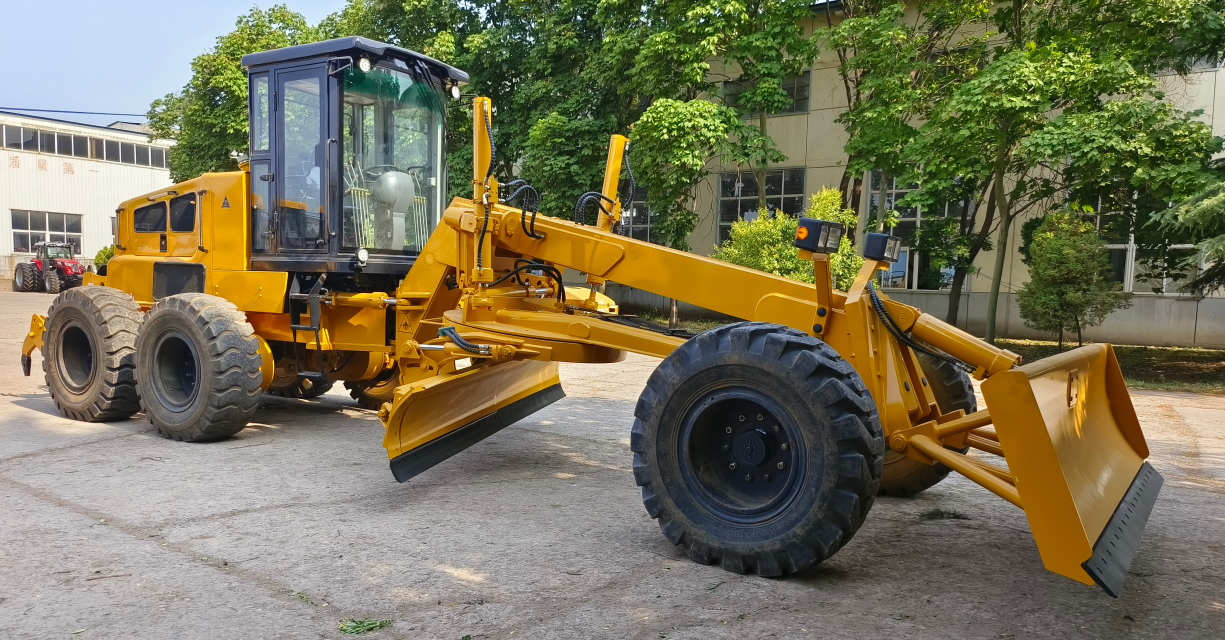
Grader faults mainly involve the engine, hydraulic system, electrical system, transmission system, and working device (blade). Inspect each system in sequence, combining visual observation, listening, touching, and instrument detection to identify faults accurately.
2.1 Engine System Inspection
The engine is the power core of the grader; common faults include difficulty starting, insufficient power, abnormal noise, and overheating. Inspection points are as follows:
- Starting System Check: If the engine fails to start or is difficult to start, first check the battery voltage and terminal connections—loose or corroded terminals can cause poor contact. Check the fuel system for clogged fuel filters, air in the fuel line, or fuel pump failure. Inspect the starter motor and generator for damage, and use a diagnostic tool to check for sensor faults (e.g., crankshaft position sensor, temperature sensor).
- Power and Operation Check: If the engine has insufficient power, check the air filter for blockages that cause insufficient air intake. Inspect the turbocharger for air leakage or impeller damage, and check the fuel injector for carbon deposits or insufficient injection pressure. Examine the exhaust system (such as the DPF particle filter) for clogging, which can affect exhaust efficiency and reduce power.
- Noise and Temperature Check: Start the engine and listen for abnormal noises (such as knocking, squealing, or rattle). Abnormal knocking may indicate problems with the cylinder or piston, while squealing may be caused by loose fan belts. Check the coolant level and temperature gauge—overheating may be due to a clogged radiator, faulty fan, or insufficient coolant. Also, check the engine oil level and quality; black or emulsified oil indicates the need for replacement.
2.2 Hydraulic System Inspection
The hydraulic system controls the movement of the grader’s blade, steering, and other working devices; common faults include insufficient pressure, slow or stuck hydraulic action, and oil leakage. Inspection steps are as follows:
- Oil Level and Quality Check: Check the hydraulic oil level with the oil level gauge; if it is too low, refill with the specified type of hydraulic oil. Observe the oil quality—cloudy, discolored, or contaminated oil can cause valve blockages and component wear. Replace the oil and clean the oil tank and filter element if necessary.
- Pressure and Leakage Check: Use a pressure gauge to measure the hydraulic system pressure. Insufficient pressure may be caused by a worn or internally leaking hydraulic pump, a stuck relief valve, or improper pressure adjustment. Check all hydraulic hoses, joints, and seals for oil leakage—apply a soap and water solution to hoses to detect small leaks. Tighten loose fittings or replace damaged hoses and seals.
- Working Device Check: Operate the blade to check if it raises, lowers, tilts, and rotates smoothly. If the blade moves slowly or gets stuck, check for high hydraulic oil temperature (caused by a clogged radiator or faulty fan), a stuck control valve, or a failed solenoid valve. If the blade cannot be fixed at a specific angle, inspect the locking pin and hydraulic lock solenoid valve for damage or failure.
2.3 Electrical System Inspection
The electrical system controls the engine start, lights, instrument panel, and other electrical components; common faults include power failure, instrument failure, and abnormal operation of electrical components. Inspection points are as follows:
- Battery and Circuit Check: Check the battery’s charge status and terminal connections; clean corroded terminals and ensure they are tight. Inspect the fuse box for blown fuses and replace them with fuses of the correct specification. Check the wiring harness for damage, aging, or loose connections, especially in areas prone to friction (such as near the steering wheel and working device).
- Instrument and Indicator Check: Turn on the ignition switch and check if the instrument panel displays normally (e.g., speed, oil pressure, temperature, fault codes). If the instrument has no display or displays abnormally, check the instrument power supply and wiring. Use a diagnostic tool to read fault codes for electrical system malfunctions (e.g., low system voltage, controller restart error, forward/reverse input error) and troubleshoot accordingly.
Electrical Component Check: Inspect the lights (headlights, taillights, turn signals), horn, and wiper for normal operation. Check the solenoid valve, relay, and controller for visible damage; use an ohm meter to check the solenoid coil resistance and cable continuity to ensure they are within the specified range.
2.4 Transmission System Inspection
The transmission system (including torque converter and main clutch) is responsible for transmitting engine power to the wheels; common faults include difficulty shifting, gear grinding, slippage, and abnormal noise. Inspection steps are as follows:
- Torque Converter Check: Check the torque converter’s operating pressure and outlet pressure. Low pressure may be caused by a low oil level, a stuck pressure valve, or a damaged hydraulic pump—add oil, remove contaminants, or repair/replace the hydraulic pump as needed. If the torque converter oil temperature is too high, check the oil for aluminum dust: a large amount of aluminum dust indicates damage to internal components (e.g., pump wheel, turbine), requiring repair and replacement of damaged parts. A small amount of aluminum dust indicates dimensional errors in major components, requiring disassembly and inspection.
- Main Clutch Check: If the gearbox has difficulty shifting, incomplete clutch disengagement, or gear grinding, check the clearance between the clutch release disc and release bearing—adjust to maintain a 25mm distance between the one-way thrust bearing and release disc. Measure the end face runout of the release disc (control within 0.15-0.20mm) and check for gaps between the release pawls and release disc. Press the release disc in all directions and tap gently with a wooden stick to eliminate uneven force and prevent friction disc deformation.
2.5 Working Device (Blade) Inspection
The blade is the core working component of the grader; common faults include wear, shaking, deviation, and inability to maintain position. Inspection points are as follows:
- Blade Wear and Fixing Check: Inspect the blade for wear—replace it when the wear reaches 1/3 of its original thickness, and replace in groups to ensure balance. Check the blade bolts for looseness and tighten them according to the specified torque. Clean dirt and debris from the back of the blade to prevent corrosion.
- Blade Movement Check: If the blade shakes or deviates during operation, check the bolt tightness, hydraulic pipeline sealing, and turntable bearing wear. Lubricate the slewing mechanism and adjust the hydraulic system pressure to ensure stability. If the blade cannot be raised or lowered, check the laser receiver (if equipped) for proper alignment, hydraulic flow direction, and electrical connections.
3. Common Fault Identification and Handling Summary
To improve inspection efficiency, here is a summary of common grader faults, their possible causes, and handling methods:
Fault Phenomenon | Possible Causes | Handling Methods |
|---|---|---|
Engine fails to start | Low battery, loose terminals, clogged fuel filter, faulty starter | Charge battery, tighten/clean terminals, replace fuel filter, repair/replace starter |
Hydraulic pressure insufficient | Low hydraulic oil, worn hydraulic pump, stuck relief valve | Refill/replace hydraulic oil, repair/replace hydraulic pump, clean/adjust relief valve |
Blade cannot be fixed | Broken locking pin, failed hydraulic lock | Replace locking pin, check hydraulic lock solenoid valve |
Difficulty shifting | Improper clutch clearance, stuck clutch components | Adjust clutch clearance, clean/replace stuck components |
Electrical instrument failure | Blown fuse, loose wiring, faulty sensor | Replace fuse, tighten wiring, replace faulty sensor |
4. Post-Inspection Handling and Preventive Measures
4.1 Post-Inspection Handling
- For identified minor faults (e.g., loose bolts, insufficient oil), handle them immediately on-site to avoid further damage.
- For major faults (e.g., damaged engine components, hydraulic pump failure), stop the grader operation immediately, mark the fault location, and notify professional maintenance personnel for repair. Do not disassemble or repair complex components without authorization to prevent secondary damage.
- Record the inspection results, fault phenomena, causes, and handling methods in the maintenance log for future reference and regular analysis.
4.2 Preventive Measures
Regular maintenance is the key to reducing grader faults. Implement the following preventive measures:
- Daily Inspection: Before operation, check oil and coolant levels, tire condition, lights, and blade wear. After operation, clean the equipment and check for oil leakage and loose parts.
- Regular Maintenance: Follow the manufacturer’s maintenance schedule—replace oil and filters every 250-500 hours, flush and inspect the hydraulic system every 1000 hours, replace coolant every 6 months, and check the gearbox and transmission annually.
- Lubrication and Anti-Corrosion: Regularly lubricate the slewing plate bearings and hinge points of the tilting mechanism with high-pressure resistant grease. Spray anti-rust agent during non-operating periods to prevent rusting.
- Operator Training: Ensure operators are familiar with the grader’s operation procedures and can identify basic faults. Avoid improper operation (e.g., overloading, abrupt starting/stopping) that can cause equipment damage.
5. Conclusion
Inspecting grader faults requires a systematic, step-by-step approach, combining safety precautions, visual observation, instrument detection, and professional knowledge. By following the procedures outlined in this guide, operators and maintenance personnel can quickly and accurately identify faults, handle them in a timely manner, and implement effective preventive measures. This not only ensures the normal operation of the grader but also extends its service life, reduces maintenance costs, and guarantees the smooth progress of construction projects. For complex faults not covered in this guide, consult the equipment manufacturer or professional maintenance personnel for support.